UVM RAL Fundamentals
Every UVM testbench past a certain size ends up with a
register abstraction layer
. The interesting question isn’t whether to use RAL. It’s whether the team understands what it’s actually modeling, or whether it’s being used as a black box that happens to generate write() and read() calls. This article covers the pieces that matter: what the model represents, how a value gets from a sequence to the
DUT
and back, and where the abstraction leaks.
What the register model actually is
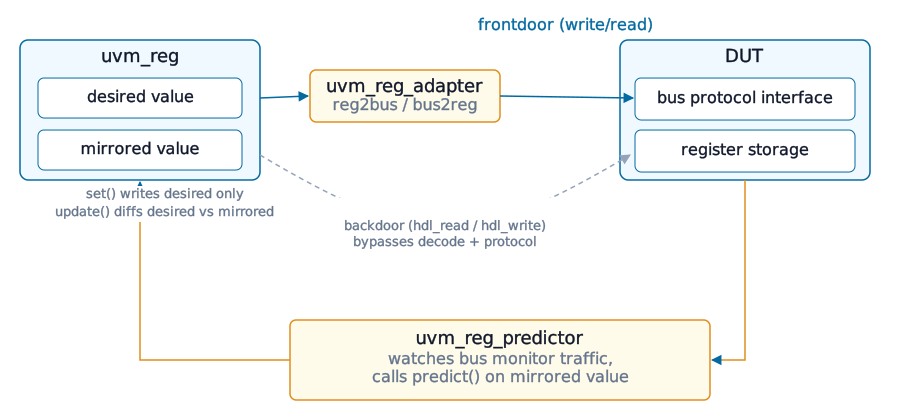
A uvm_reg is not a register. It’s a software-side model of one.
set() changes the desired value with no bus activity at all. update() compares desired against mirrored and issues a bus write only if they differ. write() does both in one call: set, then issue the transaction.
1// set() + update(): stage several field changes, one bus write
2csr.mode.set(2'b10);
3csr.enable.set(1'b1);
4csr.update(status);           // one write, combined value
5
6// write() collapses set+update into a single call
7csr.write(status, 32'h0000_0006);
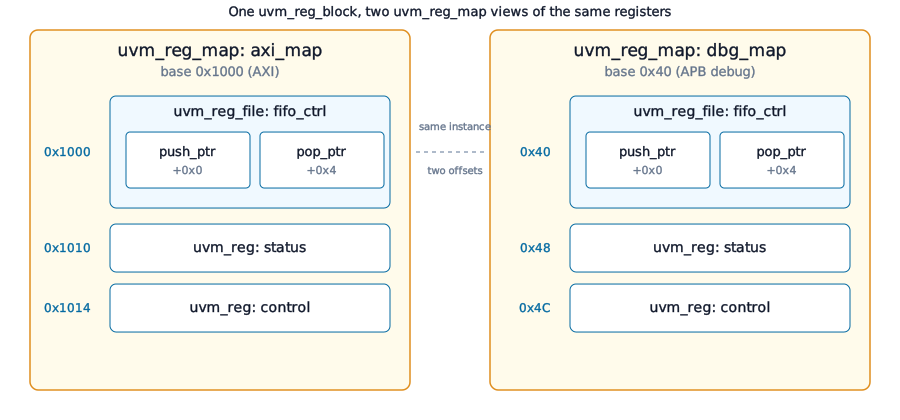
The model organizes into uvm_reg_block for a functional grouping of registers, uvm_reg_map for an address space a given register is visible through, and uvm_reg_file for grouping without necessarily implying an address map of its own. A block can have more than one map. That’s how the same register set gets modeled once but verified as reachable through two different physical paths, which matters the moment there’s more than one bus master in the picture. A later article in this series comes back to exactly that case.
Frontdoor vs. backdoor
A frontdoor access goes through the actual protocol path: an AXI write, an APB transfer, whatever the bus happens to be. It exercises the real hardware path, including the interconnect, the register’s decode logic, and any protocol-level timing. A backdoor access bypasses all of that and pokes the register’s storage directly via an
HDL
path (add_hdl_path), using hdl_read/hdl_write under the hood. It’s instantaneous, and it never touches the decode logic at all.
1// frontdoor: goes through the adapter and the real bus
2csr.write(status, 32'h1, UVM_FRONTDOOR);
3
4// backdoor: direct HDL poke, no bus activity at all
5csr.write(status, 32'h1, UVM_BACKDOOR);
6
7// wiring a register (or a whole block) to its HDL path
8csr.mode.add_hdl_path_slice("u_dut.u_ctrl.mode_reg", 0, 8);Backdoor is for setup, preloading a register to a known state before a test that isn’t about that register, or for checking storage frontdoor genuinely can’t reach cheaply. It shouldn’t be a default substitute for frontdoor testing just because it’s faster.
Mirrored value, desired value, and why the distinction survives
The mirrored value tracks the testbench’s belief about hardware state, updated automatically after a successful frontdoor access (via the predictor, more on that below) or explicitly via predict(). The desired value works as a staging area. Call set() on five fields of a register and the desired value accumulates all five changes before a single update() issues one bus write with the combined result.
The distinction breaks down if a test writes via write() and then reads the desired value expecting it to reflect what hardware now holds after some side effect, a write-1-to-clear bit, say. Desired reflects intent at the moment of the call. It doesn’t track what happens to the value afterward inside the hardware. Mirrored is supposed to do that, and even mirrored only gets it right if the model knows about the side effect in the first place, which is what access types (Register Access Types Aren’t Symmetric) and volatility, covered later in this series, are for.
Adapters: translating between RAL and the bus
RAL has no idea what bus protocol sits underneath it. The uvm_reg_adapter handles the translation: reg2bus() converts a generic uvm_reg_bus_op into whatever sequence item the driver consumes, an axi_write_item, an apb_transfer, whatever the agent expects. bus2reg() does the reverse for reads. Write the adapter once per protocol and every register behind that protocol reuses it. Swap the interconnect, write a new adapter, and the register-level tests above it don’t need to change.
 1class axi_reg_adapter extends uvm_reg_adapter;
 2  `uvm_object_utils(axi_reg_adapter)
 3
 4  function uvm_sequence_item reg2bus(const ref uvm_reg_bus_op rw);
 5    axi_write_item item = axi_write_item::type_id::create("item");
 6    item.addr  = rw.addr;
 7    item.data  = rw.data;
 8    item.write = (rw.kind == UVM_WRITE);
 9    return item;
10  endfunction
11
12  function void bus2reg(uvm_sequence_item bus_item, ref uvm_reg_bus_op rw);
13    axi_write_item item;
14    $cast(item, bus_item);
15    rw.data = item.data;
16    rw.kind = item.write ? UVM_WRITE : UVM_READ;
17    rw.status = UVM_IS_OK;
18  endfunction
19endclass
Predictors: keeping the mirror honest
A uvm_reg_predictor watches bus traffic, typically by subscribing to the monitor’s analysis port, and calls predict() on the relevant register whenever it observes a transaction that should update the mirrored value. This is what lets the mirrored value track writes that didn’t originate from a RAL write() call: a firmware sequence hammering the bus directly, or a virtual sequence issuing raw bus transactions for a corner-case timing test. Without a predictor wired up, the mirrored value only reflects RAL-initiated traffic, and any test mixing RAL access with raw bus traffic sees mirror/hardware mismatches that have nothing to do with an actual bug. The model simply never heard about the write.
1// connecting the predictor to the real bus monitor is what
2// makes non-RAL traffic visible to the mirrored value
3predictor.map     = reg_block.get_default_map();
4predictor.adapter = axi_adapter;
5monitor.ap.connect(predictor.bus_in);Where this is going
Everything above assumes a register behaves predictably. Write a value, read it back, get the same value. Most registers don’t. The next article covers the access-type field RAL uses to decide what “predictably” even means for a given register, and why treating it as one axis instead of two is where a lot of register test plans go wrong.