Wire up a uvm_reg_predictor – with explicit prediction, nothing else updates the mirror
This exercise has a walk: One register write, end to end. It plays step by step beside the code.
blk’s map runs with auto-prediction off (set_auto_predict(0), in the test), as real testbenches do when something besides the register model can touch the DUT and the mirror has to follow observed bus traffic. blk.r.write(...) still writes over the bus but leaves the mirror alone. Only a uvm_reg_predictor updates it, and only once it has .map and .adapter set and bus transactions arriving on bus_in.
predictor is already constructed in env::build_phase (in the test), but not configured or connected.
RequirementsIn env::connect_phase
predictor.mapandpredictor.adapterare the map and adapter the bus uses.drv.ap, where the driver broadcasts every access it completes, is connected topredictor.bus_in.
Right nowmirror=0 after first write, want aa. Setting .map and .adapter alone isn’t enough: the predictor’s write() is never called until bus_in has a connection.
Done whenAfter each of the two writes in the test, blk.r.get_mirrored_value() equals what was just written. Missing either piece leaves the mirror at its reset value, 0.
One working answer: brokenbench's own fix for this exercise. Try a few runs first.
What changes, against the code you started with:
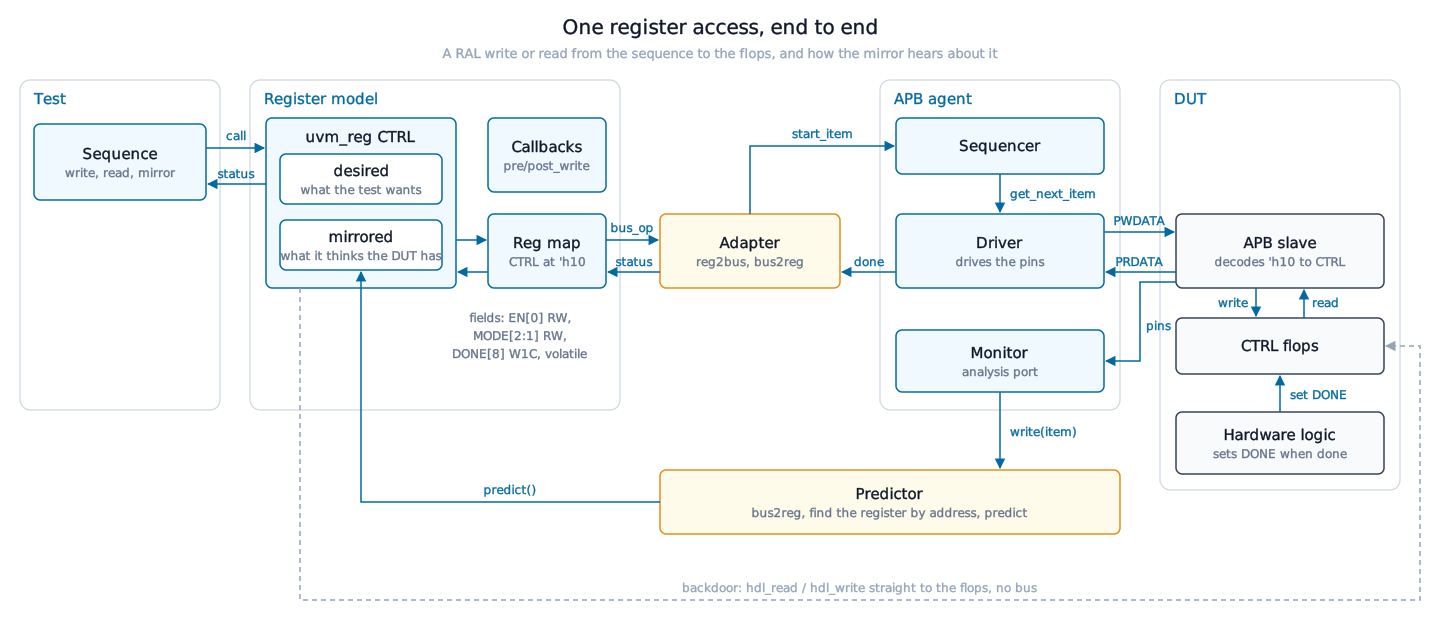
All 17 steps
- In the test (Testbench). The sequence calls
csr.write(status, 'h005): EN = 1, MODE = 2. The first thingwrite()does isset(), so the desired value becomes ‘h005 before anything moves. The mirrored value stays at ‘h000: nothing has reached the hardware yet. UVM RAL Fundamentals - The
pre_writecallbacks run, the fields’ first and then the register’s. A callback can change the value about to be written, or set the status toUVM_NOT_OK, which ends the write here with nothing on the bus. Register Callbacks in Depth - The register hands the access to its map. The map knows CTRL’s offset in this address space, ‘h10, and which sequencer and adapter serve it. The same register in a second map would have a second address and a second bus. UVM RAL Fundamentals
- The map builds a generic
uvm_reg_bus_opand calls the adapter’sreg2bus(), which turns it into an APB item. Only the adapter knows the protocol, so swapping the bus means writing a new adapter, not touching the tests. UVM RAL Fundamentals - The map runs
start_itemandfinish_itemon the APB sequencer, from inside the calling sequence. The item waits in line behind any other traffic on that sequencer, like any other item. SoC-Level Register Stress Patterns - The driver takes the item with
get_next_item. - On the bus (DUT). The driver puts the transfer on the pins: a setup phase, then an access phase with PENABLE high, until the slave raises PREADY.
- The slave decodes ‘h10 to CTRL and the flops take ‘h005. This is the only step that changes the hardware. Everything after it is the testbench catching up.
- Back in the testbench (Testbench). Two things happen at once. The driver calls
item_done, which lets the map’sfinish_itemreturn. And the monitor, which watches the same pins, publishes the transfer it saw on its analysis port. - The map calls
bus2reg()on the finished item to get the status:UVM_IS_OK, since PSLVERR was low. With the predictor doing the predicting, the map’s auto-predict is off, so the mirror is not touched here. UVM RAL Fundamentals - The monitor’s item reaches the predictor’s
bus_inexport. - The predictor runs its own
bus2reg(), finds CTRL by address ‘h10 and calls itsdo_predict(). Each field applies its access policy: EN and MODE take the written value; DONE was written 0, and writing 0 to a W1C bit changes nothing, so it stays 0. Mirrored and desired both become ‘h005. Register Access Types Aren't Symmetric - Back in the register, the
post_writecallbacks run, the register’s and then each field’s. They see the final status. Register Callbacks in Depth write()returnsUVM_IS_OKto the sequence. Nothing in UVM orders this return against the predictor’s update: both happen in the same time step, so code that reads the mirror straight afterwrite()is relying on scheduling luck. Volatile Registers and the Predictor Problem- Through the backdoor (Testbench). The same start:
set()makes desired ‘h003, and thepre_writecallbacks run as before. UVM RAL Fundamentals - There is no map, adapter or bus. The register reads the flops through their HDL path (‘h005), works out what each field would hold after this write (DONE is W1C and written 0, so it keeps what it read), and deposits ‘h003 straight into the flops. UVM RAL Fundamentals
- The register predicts its own mirror, ‘h003. The APB slave, monitor and predictor never saw this write, and the decode of ‘h10 was never exercised. That is why backdoor is for setup, not for testing the access path. What the Built-in Sequences Actually Test
- Install Docker and start it: Docker Desktop on macOS and Windows, Docker Engine on Linux.
- Run this in a terminal:
docker run --pull always --rm -p 127.0.0.1:8787:8787 ghcr.io/adibis/brokenbench-runner - Leave it running. This page connects to it by itself.
Looking for a runner on this computer…
The first start downloads about 250 MB; after that it starts in seconds and only downloads again when there's an update. Your code goes to the runner on your computer, not to chipdv.io.