Enable a device through update() without clearing a pending interrupt in the same register
This exercise has a walk: A status bit the mirror never heard about. It plays step by step beside the code.
ctrl_reg has two fields: enable (RW) and irq_pending (W1C: writing 1 clears the pending flag in hardware). uvm_reg::update() writes the whole register, computing a value for every field. For a W1C field it inverts desired, so desired=0 becomes a write of 1. If irq_pending was never read, its desired is still the reset default 0, and update() clears a real pending interrupt nobody asked it to touch.
RequirementWrite enabler::enable_device(uvm_reg r, uvm_reg_field enable, uvm_reg_map map) so it sets enable without disturbing what irq_pending holds in hardware. It takes one extra call, first: what has to happen before desired can mean “leave this alone”?
Right nowenable=0, want 1. The stub does nothing.
Done whenA frontdoor read-back after enable_device (in the test) shows enable=1 and irq_pending=1. enable.set(1) then r.update(...) with no read first gives enable=1 but irq_pending=0.
One working answer: brokenbench's own fix for this exercise. Try a few runs first.
What changes, against the code you started with:
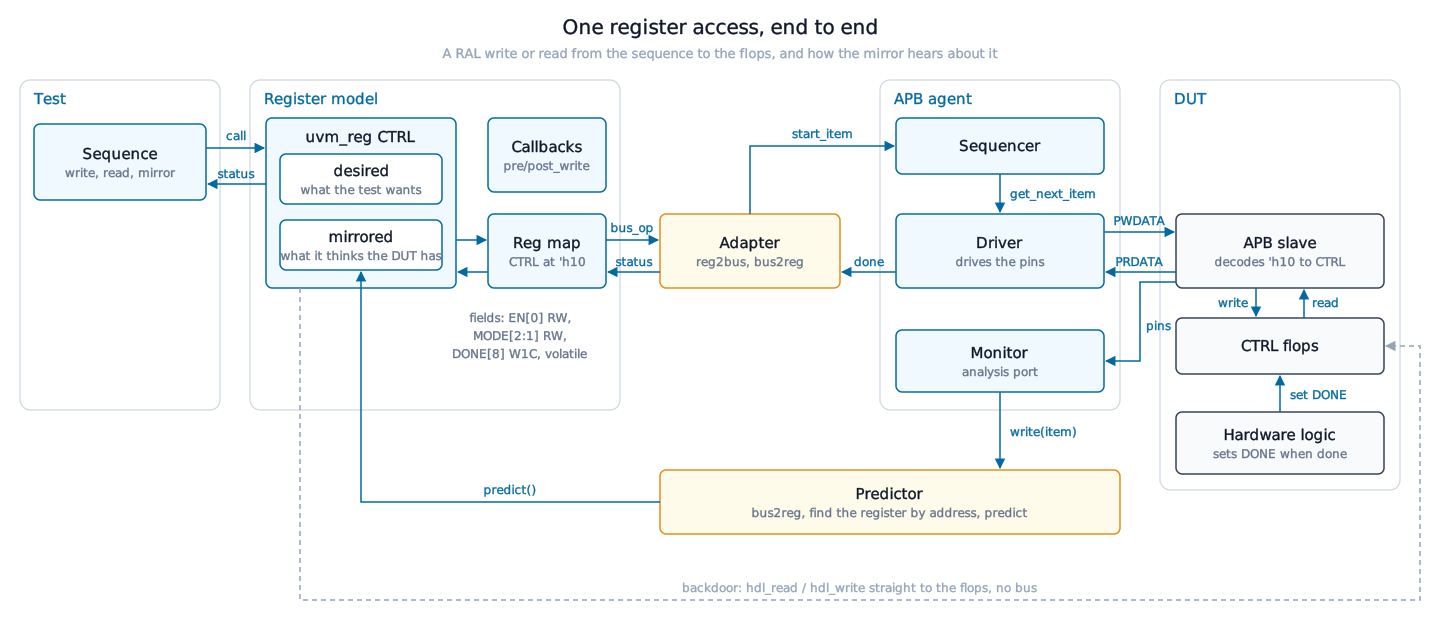
All 16 steps
- In the DUT (DUT). CTRL holds ‘h005 and the model agrees. Then the block finishes a job and its own logic sets DONE, bit 8. No bus transfer happens, so the monitor sees nothing and the mirror still says ‘h005. Volatile Registers and the Predictor Problem
- In the test (Testbench). The sequence calls
csr.mirror(status, UVM_CHECK). Before reading anything,mirror()notes the mirrored value, ‘h005, as what it expects to find. UVM RAL Fundamentals - The read takes the same route as a write: through the map and
reg2bus()to an APB item, this time with write = 0. - The item goes to the sequencer and on to the driver.
- On the bus (DUT). The driver puts a read on the pins: PADDR ‘h10 with PWRITE low.
- The slave decodes ‘h10 and reads the flops: ‘h105, DONE included.
- The value comes back on PRDATA, and the driver copies it into the item.
- Back in the testbench (Testbench). As with the write, two things happen at once: the driver hands the finished item back to the map, and the monitor publishes the read it saw.
bus2reg()pulls ‘h105 out of the item, andmirror()gets its value back.- No. The compare skips any field whose check is off, and declaring DONE volatile when it was configured turned its check off. EN and MODE are compared and match. Had DONE not been declared volatile, this read would fail with an error that looks like a DUT bug and is really a model that was never told the hardware writes this bit. Volatile Registers and the Predictor Problem
- Meanwhile the monitor’s copy of the read reaches the predictor.
- The predictor finds CTRL and predicts a read: each field takes the value read (a read-to-clear field would be predicted as 0 instead). The mirror catches up to ‘h105. Only a read could have told it. Register Access Types Aren't Symmetric
- Clearing DONE (Testbench). To acknowledge the job, the sequence writes 1 to DONE with
csr.write(status, 'h105). Inset(), a W1C field treats the 1 as a clear, so desired becomes ‘h005: what the register should read after the write, not the bits sent. Register Access Types Aren't Symmetric - On the bus (DUT). The write follows the same path as the first walk: map, adapter, sequencer, driver, then PWDATA ‘h105 on the pins.
- The 1 on bit 8 clears DONE; EN and MODE are written with the values they already hold. The flops read ‘h005 again.
- Back in the testbench (Testbench). The predictor applies the same W1C rule to the write it saw: DONE was 1 in the mirror and written 1, so it becomes 0. Desired, mirrored and the flops agree on ‘h005 again. Register Access Types Aren't Symmetric
- Install Docker and start it: Docker Desktop on macOS and Windows, Docker Engine on Linux.
- Run this in a terminal:
docker run --pull always --rm -p 127.0.0.1:8787:8787 ghcr.io/adibis/brokenbench-runner - Leave it running. This page connects to it by itself.
Looking for a runner on this computer…
The first start downloads about 250 MB; after that it starts in seconds and only downloads again when there's an update. Your code goes to the runner on your computer, not to chipdv.io.