Wiring a Register-Triggered Domain Reset End to End
Mid-Sim Reset built the general mechanism: a coordinator, ordered pre_reset()/post_reset() hooks, and a set of components that register with it. That mechanism doesn’t do anything on its own until something tells the coordinator a reset actually happened. This article is the missing piece: a real soft-reset register write, and everything that has to fire between that write landing and the domain being safe to check again.
The scenario
A power-management block exposes a domain_ctrl register. Writing a specific bit soft-resets domain A: every register in that domain reverts to its hardware reset value, any in-flight transaction targeting the domain gets aborted at the protocol level, and the domain needs a fixed number of cycles before it’s safe to touch again. Nothing about the register write itself is unusual, it’s an ordinary RAL write() call, exactly as the CSR series’ UVM RAL Fundamentals describes. What’s unusual is everything downstream of it.
Step 1: the intent rides with the write
The sequence issuing the reset doesn’t call into the scoreboard or the coordinator directly. It attaches an extension, the mechanism a later CSR-series article covers, and moves on:
 1class reset_intent_ext extends uvm_object;
 2  `uvm_object_utils(reset_intent_ext)
 3  string domain_name;
 4  int    settle_cycles;
 5endclass
 6
 7task domain_a_soft_reset_seq::body();
 8  reset_intent_ext ext = reset_intent_ext::type_id::create("ext");
 9  ext.domain_name   = "domain_a";
10  ext.settle_cycles = 40;
11
12  csr.domain_ctrl.write(status, 32'h1, .extension(ext));
13endtask
This is the same shape as the fault-injection example in the extensions article: the sequence’s only job is to describe what’s happening, not to manage every component that needs to react to it. That separation is what keeps the sequence readable and keeps the reaction logic in exactly one place instead of duplicated across every sequence that might ever trigger a domain reset.
Step 2: a callback turns the write into a coordinator event
A uvm_reg_cbs registered on domain_ctrl catches the write once it’s actually landed, and hands off to the coordinator from Mid-Sim Reset:
 1class domain_reset_callback extends uvm_reg_cbs;
 2  `uvm_object_utils(domain_reset_callback)
 3  reset_coordinator rc;
 4
 5  virtual task post_write(uvm_reg_item rw);
 6    reset_intent_ext ext;
 7    if (rw.extension != null && $cast(ext, rw.extension)) begin
 8      fork
 9        rc.announce_reset(ext.domain_name, ext.settle_cycles);
10      join_none
11    end
12  endtask
13endclass
post_write rather than pre_write matters here: the coordinator should only fire once the write has actually gone out over the bus, not before. Firing it in fork/join_none matters too: post_write runs synchronously as part of the same call chain as the write() that triggered it, so the sequence that issued the write is still parked inside that call, waiting for it to return, for as long as post_write keeps running. announce_reset() runs the full two-pass hook sequence from Mid-Sim Reset across every registered component, real work that takes real simulation time, and blocking inside post_write for all of it would stall the sequence’s register access call for exactly as long. join_none lets announce_reset() run as its own process instead, so post_write returns immediately and the write() call the sequence issued completes on schedule.
That immediacy has a cost worth naming: nothing here raises a phase objection while the detached announce_reset() is still settling, and nothing serializes two overlapping resets against the same domain. A production version needs one or both, an objection held until the coordinator finishes, and a per-domain guard against re-entering announce_reset() before a prior call’s settle window has drained.
Step 3: the coordinator’s two passes run
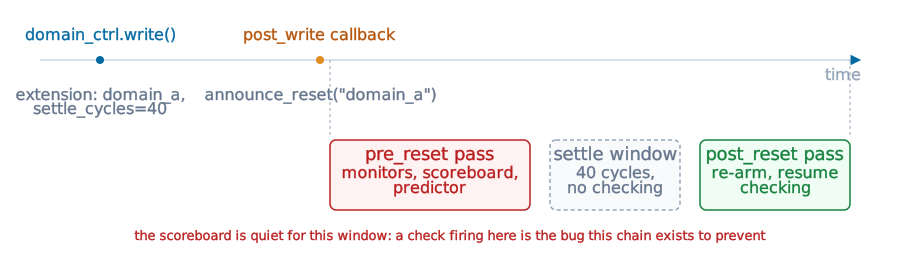
The per-component reactions are Mid-Sim Reset’s mechanism, unmodified: monitors for domain A stop sampling and discard partial transactions, the scoreboard clears its outstanding-expectation table for domain A specifically, not the whole environment, and the predictor invalidates mirrored values for every register in that domain so the next access re-establishes them from a live read rather than trusting a value that reset just made stale. What does change, covered next, is the coordinator’s own announce_reset(), extended with a settle window between the two passes.
 1class domain_scoreboard extends reset_aware_comp;
 2  function bit watches_domain(string domain);
 3    return (domain == "domain_a");
 4  endfunction
 5
 6  task pre_reset(string domain);
 7    clear_outstanding_expectations(domain);
 8    `uvm_info("RST", $sformatf("scoreboard quiesced for %s", domain), UVM_LOW)
 9  endtask
10
11  task post_reset(string domain);
12    rearm_checking(domain);
13  endtask
14endclass
Step 4: the settle window
settle_cycles from the extension is what tells the coordinator, or more precisely whatever’s waiting to call post_reset(), how long the domain needs before it’s safe to check again. This is where a naive version of this pattern goes wrong: firing post_reset() immediately after pre_reset() re-arms checking before the domain has actually finished resetting in the DUT, and the first access after re-arming compares against a domain that hasn’t settled yet.
This is the one real change to Mid-Sim Reset’s coordinator: announce_reset() there took a single domain argument and ran both passes back to back. Here it gains a second, defaulted argument so every existing single-argument call site keeps compiling unchanged, while a caller that actually has a settle time to report can pass it. The two-role-pass ordering from Mid-Sim Reset, every observer’s pre_reset() before any consumer’s, carries over unchanged; only the settle window between the pre- and post-reset hooks is new:
 1task reset_coordinator::announce_reset(string domain, int settle_cycles = 0);
 2  foreach (m_registered[i])
 3    if (m_registered[i].watches_domain(domain) && m_registered[i].is_observer())
 4      m_registered[i].pre_reset(domain);
 5
 6  foreach (m_registered[i])
 7    if (m_registered[i].watches_domain(domain) && !m_registered[i].is_observer())
 8      m_registered[i].pre_reset(domain);
 9
10  if (settle_cycles > 0)
11    repeat (settle_cycles) @(posedge clk);
12
13  foreach (m_registered[i])
14    if (m_registered[i].watches_domain(domain))
15      m_registered[i].post_reset(domain);
16endtask
The extension is what makes this settle time a property of this specific reset event rather than a constant hardcoded into the coordinator. A different register, or a different domain, might need a different number of settle cycles, and the sequence issuing the reset is the thing that actually knows the answer, the same way it knows the burst length or the master tag in the extensions article’s other examples.
What this buys over the alternative
The alternative to this whole chain is a sequence that manually calls scoreboard.disable(), waits some number of cycles it picked by guessing, and calls scoreboard.enable() again, repeated in every sequence that might trigger a reset. That version works until two sequences trigger overlapping resets on different domains and their manual disable/enable windows interleave incorrectly, or until someone adds a new domain and forgets to update the guessed wait count in a sequence written before that domain existed. The coordinator version has exactly one place that knows how to quiesce and re-arm a domain, exactly one place the settle timing is threaded through, and every sequence that ever needs to trigger a reset gets that behavior for free by attaching an extension, the same win the CSR extensions article makes for error injection, applied here to a reset instead of a fault.